ChatGPT Ads Launch in Germany: What Self-Employed Need to Know
 Nelija
Contents
Since August 2026, you can advertise in ChatGPT—in Germany, Austria, and 29 other European countries. The question isn't whether you can, but whether it's worth your budget and how to test it without drowning in data.
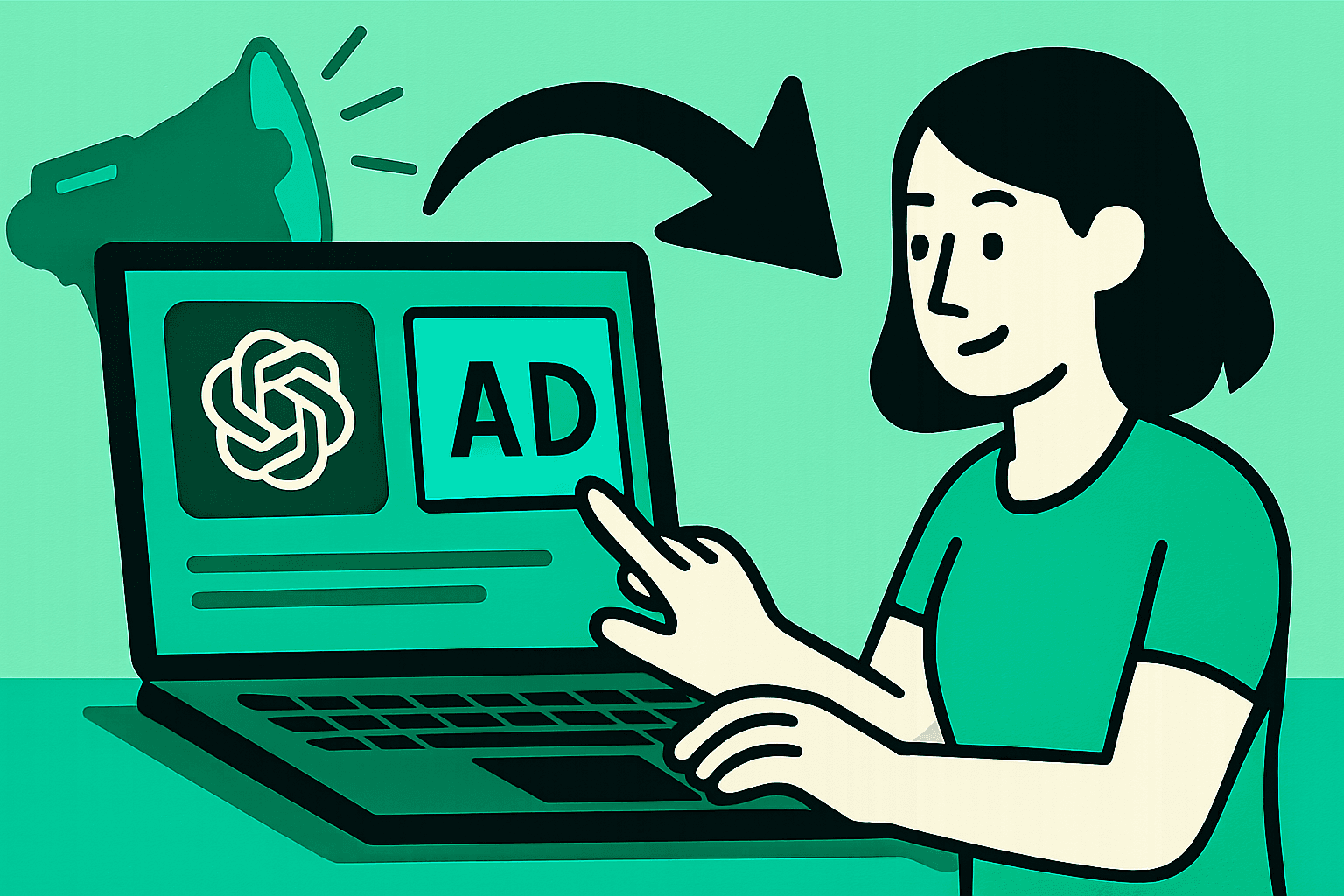
Here's the thing: OpenAI went live with ads in Europe on August 24, 2026. No more beta, no waitlist games. You can now run ads while a user is talking to ChatGPT. The ad appears below a response, clearly labeled, only for Free and Go users. Plus, Pro, Business, and Enterprise remain ad-free.
What you'll get in this article: formats, costs, placements. An honest comparison with Google Ads. When a test makes sense, when it doesn't. And why you should do the math before burning budget.
What ChatGPT Ads Are
ChatGPT Ads are sponsored ads within ChatGPT. No banners, no pop-ups. A box below a response, when OpenAI finds a relevant ad for the current conversation context.
OpenAI started testing on February 9, 2026 in the US, only for logged-in adults on Free and Go plans. Source The European expansion to 31 countries—including Germany and Austria—was announced for August 2026. Source Third-party sources cite August 24, 2026 as the German market launch. Source
Important: Plus, Pro, Business, Enterprise, and Education remain ad-free. Ads also don't target minors. Source
OpenAI emphasizes that ads in Europe are not personalized based on complete chat histories or stored Memories. Relevance may derive from current conversation context, language, and location. Sensitive topics like health and politics are restricted in the Ad Policies. Source
Advertisers have no influence on the organic ChatGPT response. Ad and response are displayed separately and labeled. Source
Formats and Placements
A standard ad unit contains, according to OpenAI:
- Advertiser Name
- Favicon or Logo
- Headline
- Description text
- Landing page URL
Placement is below a ChatGPT response, when relevant sponsored content is available. The ad sits in a separate box, labeled as sponsored. Source
Campaign Objectives
OpenAI lists three core objectives:
- Reach: Impressions, reach
- Clicks: Traffic to landing page
- Conversions: Optimization for supported conversion events
Billing and Optimization
- Reach campaigns use CPM (Cost per Mille, cost per thousand impressions).
- Click campaigns use CPC (Cost per Click).
- Conversion-optimized campaigns may still be billed per valid click; OpenAI calls this oCPC.
- For Reach, you set a maximum CPM bid; for Clicks, a maximum CPC bid at ad group level.
OpenAI recommends for CPC campaigns a starting maximum bid of $3 to $5 per click. That's a recommendation, not a guaranteed German market price. Source
Additional Formats
Market reports mention product feed campaigns and product-based variants like single dynamic products or carousels. These should be understood as reported platform status, not a permanently complete format list. Source Source
OpenAI's original description spoke of ads that only appear when relevant to current conversation context. This suggests contextual targeting rather than a classic keyword list like Google Search Ads. Source
What ChatGPT Ads Cost—and What You Really Need to Know
OpenAI doesn't publish a binding German CPC price list. Blanket statements like "a click costs exactly X euros in Germany" aren't reliable. Source
For CPC campaigns, OpenAI suggests $3 to $5 maximum CPC as orientation. With an assumed test budget of €300, that would roughly equal 60 to 100 clicks, if every click were actually bought at the upper bid range. That's a calculation illustration, not a forecast. Source
Third-party sources report a daily budget starting at €15 for Germany. This figure doesn't come from the cited OpenAI help and should be understood as observed platform status. Source Source
One third-party source mentions a maximum standard bid of $60 CPM and pilot measurements around $25 CPM. These aren't reliable German market benchmarks. Source
Sensible Test Budgets for Self-Employed
These amounts aren't official OpenAI prices, but planning figures:
- Minimal test: €15 per day over 14 days = €210 media budget
- Small reliable test: €15 to €30 per day over 30 days = €450 to €900
- Lead or sales test: additionally budget for tracking, landing page, and possibly creatives
Small budgets shouldn't simultaneously test multiple countries, audiences, objectives, and messages. Better: one region, one concrete offer, one campaign objective, one landing page, one clear conversion point.
ChatGPT Ads vs. Google Ads: The Honest Comparison
| Criterion | ChatGPT Ads | Google Ads |
|---|---|---|
| User Intent | User formulates a question or task in dialogue | User enters a search query |
| Targeting | Contextual relevance within conversation | Primarily keywords, search intent, audiences, location |
| Placement | Below a ChatGPT response | Search results, Display Network, YouTube, Shopping |
| Pricing Model | CPM, CPC, conversion-oriented options | Depending on campaign: CPC, CPM, CPA, or automated bidding |
| Data Availability | New market with limited German benchmarks | Established market with more historical account data |
| Measurement Risk | Less experience, possible differences between chat interaction and click | More mature measurement and optimization ecosystems |
| Advantage for Small Budgets | Access to new, conversational context | Precise coverage of existing search demand |
| Main Risk | Still unclear reach, prices, and conversion quality | High competition for purchase-intent keywords and potentially high CPCs |
Google Ads is usually the better first choice when there's already clearly measurable search demand, like "tax advisor Munich" or "solar panel quote Cologne".
ChatGPT Ads may be interesting when your offer needs explanation, involves multiple solution paths, or users typically ask advisory-oriented questions.
A direct CPC comparison isn't credible as long as OpenAI doesn't publish representative German average values. A cheaper click isn't automatically more economical: what matters are qualified leads, sales, and contribution margin.
For a fair test, Google Ads and ChatGPT Ads should ideally use comparable landing pages, identical conversion definitions, separate UTM parameters, the same evaluation period, and sufficient lead follow-up time.
Who Should Test
A test is particularly plausible for:
- local services
- travel and leisure providers
- household and lifestyle products
- digital products
- educational offerings
These areas are mentioned in OpenAI's Ad Policies as core consumer categories of the initial test period. Source
Suitable offers have:
- clear target audience
- short or medium purchase decision
- clear landing page
- measurable action like inquiry, booking, purchase, or appointment
- sufficient margin per new customer
Less suitable are:
- heavily regulated offers without verified advertising claims
- products with very low order value
- offers without own landing page
- services with long sales cycles and unclear attribution
- businesses wanting only brand awareness without measurement concept
Calculate Profitability First
For small budgets, a test should only start when you know the maximum economical click price. Approximately:
maximum CPC = lead or customer value × allowable marketing percentage × conversion rate
Example: If a new customer brings €500 contribution margin, 20% may be spent on marketing, and 5% of clicks convert to customers, the calculated maximum CPC is €5. These values are example assumptions and must be replaced with your own data.
How to Prepare
Set Up Tracking First
- UTM parameters for source, campaign, ad group, and creative
- Form or purchase tracking
- Phone and appointment tracking
- CRM attribution
- documented definition of "lead" and "qualified lead"
More on this: Defining Conversions
Prepare Landing Page
- one message per page
- clear value proposition
- price or offer range
- trust signals
- short contact option
- mobile optimization
- privacy policy and consent mechanisms
Help with copywriting: The Ultimate ChatGPT Prompt for Your Website Copy
Test Ad Variations
- specific rather than general headlines
- clearly state benefit and target audience
- no unsubstantiated superlatives
- one call to action
- closely align ad text and landing page language
More on ad creatives: Creating Ad Creatives
Initially Limit Campaigns
- only one country or region
- only one objective
- set daily budget
- exclude sensitive or unsuitable topics
- regularly review conversation contexts and actual leads
Consider Privacy and Brand Risks
- don't transfer confidential customer data in ads or tracking
- review consents and data processing agreements with your service providers
- use third-party brands, medical claims, and financial promises only with legal review
- don't assume contextual advertising is automatically permissible without privacy review
Common Launch Mistakes
- Treating ChatGPT Ads like Google keyword ads, even though relevance targeting is contextual
- Presenting a single CPC as "German average" when OpenAI hasn't published a reliable German price list
- Testing multiple products, cities, and audiences simultaneously with €15 daily budget
- Counting clicks as success without measuring qualified leads or revenue
- Using a general homepage instead of an ad-aligned landing page
- Setting up conversion tracking after campaign launch
- Presenting ChatGPT responses, recommendations, or brand mentions as guaranteed advertising effect
- Mixing organic ChatGPT visibility and paid ads
- Overlooking that Plus, Pro, Business, Enterprise, and Education are ad-free and deriving too large a reachable user base
- Adopting third-party German claims as official OpenAI rules without verification
GEO: The Free Alternative to ChatGPT Ads
GEO stands for Generative Engine Optimization: structuring content so AI systems can more easily understand, categorize, and consider it as a source.
GEO isn't a guaranteed free alternative to ads. Costs still arise for research, editing, updates, technical optimization, and digital PR.
Sensible GEO Measures
- directly answer specific user questions
- use clear definitions and reliable sources
- transparently present author, company, and expertise
- maintain current prices, services, and use cases
- use structured headings and FAQ content
- clearly identify regional information
- publish own studies, data, and case examples
- build mentions on trustworthy third-party sites
More on this: GEO/LLM Visibility and llms.txt: The Secret File That Makes AI Recommend Your Website
GEO typically works slower and less controllably than paid ads. In return, good content can generate organic visibility over longer periods.
Paid ads and GEO aren't mutually exclusive:
- Ads deliver measurable traffic short-term
- GEO builds discoverability and trust long-term
- Both channels should be measured separately
Further perspective: GEO Instead of SEO: Why Your Business Must Be Visible in AI Search Engines
What I'd Do Differently
If I were starting with ChatGPT Ads today, I wouldn't test the platform—I'd test my own measurement infrastructure.
Specifically: First Google Ads with clear tracking, then ChatGPT Ads with identical setup. Same landing page, same UTM structure, same conversion definition. Only then can you fairly compare platforms.
I also wouldn't start with minimum budget, but with the budget that gives me statistically significant data. At 5% conversion rate, you need at least 100 clicks to see even one conversion. At €3 CPC, that's €300. At €5 CPC, it's €500.
And I wouldn't launch any campaign before calculating my maximum economical CPC. If your offer can only support €2 CPC but OpenAI recommends $3 to $5, the test isn't economically sensible.
More on campaign analysis: Understanding Campaign Analysis and Optimizing Campaigns
Frequently Asked Questions
Are ChatGPT Ads already available in Germany?
Yes. According to OpenAI, the European expansion to 31 countries including Germany was announced for August 2026; third-party sources cite August 24, 2026 as the German market launch. Source Source
Who sees ads in ChatGPT?
Users on Free and Go plans. Plus, Pro, Business, Enterprise, and Education remain ad-free. Source
How much does a click cost on ChatGPT Ads?
OpenAI doesn't publish a binding German average price. As starting orientation, OpenAI suggests a maximum CPC bid of $3 to $5. Source
Is there a minimum budget for ChatGPT Ads?
Third-party sources report a daily budget starting at €15. This should be verified in the current Ads Manager before campaign launch. Source Source
Are my ads served based on private chat histories?
No. OpenAI describes ads as contextual but excludes using chat histories or Memories for personalized advertising. Source Source
Are ChatGPT Ads better than Google Ads for small businesses?
Not universally. Google Ads has more historical data and is especially suited for covering existing search demand. ChatGPT Ads are a new, conversational channel with still limited German benchmarks. More on this: Meta Ads vs. Google Ads: Which Platform?
What formats can I book?
OpenAI lists standard ads with name, logo, headline, description, and landing page, plus objectives for Reach, Clicks, and Conversions. Third-party sources additionally report product feed and carousel formats. Source Source
Can GEO replace ChatGPT Ads?
GEO can complement paid reach long-term but is neither guaranteed free nor as immediately controllable. For short-term measurable demand, ads work; for long-term organic discoverability, high-quality, citable content makes sense. More on this: Content Marketing, SEO and GEO
The Step You Can Take Today
You don't have to launch ChatGPT Ads immediately. You don't have to launch Google Ads immediately either. But you should know today how much a click is worth to you.
Calculate it: lead or customer value, allowable marketing percentage, estimated conversion rate. That gives you your maximum CPC. If it's below €3, ChatGPT Ads are probably too expensive right now. If it's above, you can test.
And if you don't know how to calculate that, start with tracking. UTM parameters, form tracking, CRM attribution. Without that, every campaign is guesswork.
More on this: Running Ads for Self-Employed and ChatGPT Ads and Advertising in AI Assistants
If you don't want to do this alone or want to move faster: Nelija helps you set up tracking, landing pages, and campaigns. No agency overhead, no hidden costs. Try Nelija free
Comments
Comments are only available when you are signed in. You are self-employed and want access to Nelija.com, including a free website? Message Nelija directly.