Measuring ChatGPT Ads: What Self-Employed People Really Need to See
 Nelija
Contents
Measuring ChatGPT Ads means: tracking clicks, leads, and orders separately, then comparing cost per order against your sustainable threshold. This article shows you which three conversions you need, how to track them without a large CRM, and when to increase or stop your budget after 7 and 30 days.
Here's the thing: the ad runs quickly. You see clicks in the dashboard, maybe a few form submissions. But the crucial question remains: does this generate a qualified inquiry? Does it lead to an order? And does the revenue cover the advertising costs?
Many self-employed people only look at click numbers. That's understandable, because the platform displays them prominently. But a click isn't an inquiry. An inquiry isn't a qualified lead. And a qualified lead isn't an order yet.
This article clearly separates these stages. It shows you a simple measurement plan for small budgets: goals, UTM parameters, conversions, and stop criteria. No jargon, no agency setups. Just what you need to know after 30 days: is this worth it?
What ChatGPT Ads Can Measure in October 2026
ChatGPT Ads have been available in 31 European markets since August 24, 2026, including Germany, Austria, and Switzerland. Self-service access through the OpenAI Ads Manager was activated in late August and early September. Source: OpenAI Source: Admospherics
The platform can technically measure more than just clicks. OpenAI mentions Pixel, Conversions API, attribution, reporting, and incrementality measurement. Supported conversion types include purchases, leads, app installations, and registrations. Source: OpenAI
Specifically, you can currently track these metrics:
Delivery
- Impressions: How often was the ad served?
- Reach: How many individual users saw the ad?
- Cost: How much did you spend?
Ad Response
- Clicks: How many users clicked on the ad?
- Click-through rate (CTR): Ratio of clicks to impressions.
- Average CPC: Cost per click.
- CPM: Cost per 1,000 impressions.
Website Actions
- Form submission: Did someone fill out the contact form?
- Registration: Did someone sign up for an account or newsletter?
- Inquiry: Did someone make a specific request?
- Purchase: Did someone buy or book something?
These events are captured via the OpenAI Pixel or Conversions API. Source: Econsor
Attribution
OpenAI mentions click attribution and partner solutions. One provider also describes customizable click-through attribution and a 1-day view-through window. This means: the platform attributes a conversion to the ad if the user converts within one day after viewing (without clicking) or after clicking. Source: The Keyword
Conversion Optimization
According to German market overviews, campaigns can be optimized for CPM, CPC, and conversion-optimized CPC (oCPC). This means: you can optimize for impressions, clicks, or conversions. Source: Econsor
Incrementality
According to reports, OpenAI works with partners like Haus, Measured, and WorkMagic on geographic experiments to test the additional causal effect of a campaign. This is usually too complex for small budgets initially, but shows: platform attribution and actual incremental revenue aren't the same thing. Source: Yahoo Finance
Third-Party Support
OpenAI mentions AppsFlyer, Triple Whale, Adjust, DV Rockerbox, Northbeam, Branch, Singular, Kochava, Airbridge, and Tenjin among others. For data feeds and integrations, Hightouch, Tealium, and LiveRamp are also mentioned. Source: OpenAI
That sounds like a lot. But for smaller businesses, what matters is: the platform can technically measure more than just clicks, but a measured conversion event isn't yet a qualified lead, and certainly not an order.
Why Click Numbers Aren't Enough for Self-Employed People
A click only shows that someone opened the ad or landing page. It doesn't answer whether the person fits your offer, leaves contact details, is reachable, or buys.
For local service providers, high click rates can result from curiosity, information seeking, or unsuitable users. Therefore, at least these stages should be tracked separately:
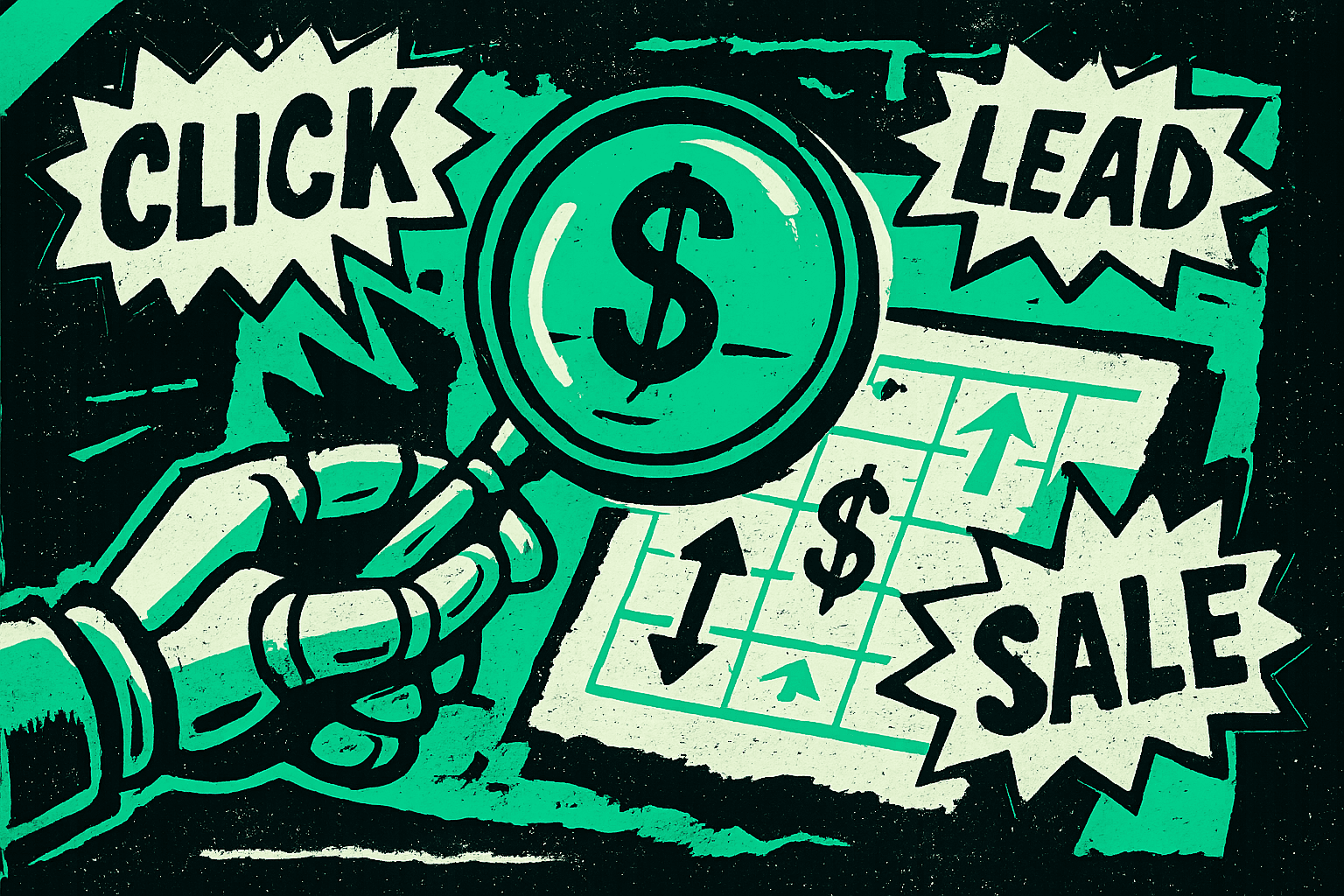
- Click: Visit via the ChatGPT ad.
- Lead: Inquiry with contact details.
- Qualified lead: Inquiry with matching need, region, budget, or desired timeframe.
- Order: Paid or confirmed service.
The core metric chain is:
Impressions → Clicks → Leads → Qualified leads → Orders → Revenue
The Most Important Formulas
- CTR (Click-through rate): Clicks ÷ Impressions × 100
- Lead rate: Leads ÷ Clicks × 100
- Qualification rate: Qualified leads ÷ Leads × 100
- Close rate: Orders ÷ Qualified leads × 100
- CPL (Cost per Lead): Ad spend ÷ Leads
- Cost per qualified lead: Ad spend ÷ Qualified leads
- CAC (Customer Acquisition Cost): Ad spend ÷ Orders
For self-employed people, CAC or cost per order is the most important control metric, not the cheapest click.
An example: You pay €3 per click, get 10 clicks for €30, resulting in 2 leads, 1 qualified lead, and 1 order. Your CAC is €30. If your average order value is €500 and your contribution margin is €200, the order is profitable. If your contribution margin is only €20, the campaign doesn't work.
The Three Conversions You Must Define
Conversion 1: Inquiry or Lead
Definition: Form submitted, callback requested, email inquiry sent, or appointment booking started.
Purpose: Measures whether the landing page turns visitors into contacts.
Not sufficient: A mere click on a phone number should only count as a lead if the call actually happens or is trackable in your CRM.
Conversion 2: Qualified Lead
Definition: Inquiry matches your service area, target audience, budget, timeframe, or minimum order value.
Implementation without large setup: Add a required field in your CRM, spreadsheet, or form for status and qualification reason.
Example statuses: New, contacted, qualified, not suitable, quote sent, won, lost.
This conversion is often not automatically recognized by the ad platform; it must be fed back from the sales process or at least evaluated manually on a regular basis.
Conversion 3: Order
Definition: Order confirmed, contract signed, or payment received.
Purpose: Shows whether advertising works economically.
For services, you should also store the order value, because orders with vastly different revenue shouldn't be valued equally.
Recommended Priority for Small Budgets
- Primary goal: Qualified lead or order.
- Secondary goal: Lead.
- Diagnostic metric: Click.
A click shouldn't be called success, but rather a preliminary stage.
UTM Tracking and Lead Capture Without Large Setup
A simple UTM scheme is sufficient:
utm_source=chatgpt
utm_medium=paid
utm_campaign=service_region_goal
utm_content=ad_a
Example:
https://example.com/consulting?utm_source=chatgpt&utm_medium=paid&utm_campaign=tax_consulting_munich_leads&utm_content=ad_aFor a small account, parameters should remain stable:
utm_source=chatgptutm_medium=paidorcpc; don't use both simultaneously in different campaigns.utm_campaignfor offer and region.utm_contentfor creative, text variant, or audience.
Without consistent UTM tagging, traffic may appear as Direct in analytics tools and can't be reliably attributed to the ad channel later. Source: Hurra
The Minimum Setup for Solo Self-Employed
- One landing page per main offer.
- One form with name, email, need, and optionally budget or timeframe.
- Hidden form fields for UTM source, campaign, and content.
- A spreadsheet or lightweight CRM with lead status.
- Weekly manual assignment of leads to qualified, not qualified, and order.
- A unique event name per conversion, such as
lead_submitted,qualified_lead, andpurchaseordeal_won.
The OpenAI Pixel is intended for browser-side events; the Conversions API enables server-side transmission. Both methods should be secured against double counting with an event ID if used in parallel. Source: Bakedwith Source: Zoda Media
For very small budgets, a complete data stack with warehouse, multiple attribution tools, and incrementality tests is usually not the first step. First, clean UTM data, consistent events, and manually maintained order status should work.
Copy-Paste Prompt: Hidden UTM Fields in Form
Create an HTML contact form for me with the following fields:
- Name (required)
- Email (required)
- Phone (optional)
- Need (textarea, required)
- Budget (dropdown: "up to €500", "€500-1,000", "€1,000-2,500", "over €2,500")
- Timeframe (dropdown: "immediately", "in 1-4 weeks", "in 1-3 months", "later")

Plus three hidden fields:
- utm_source
- utm_campaign
- utm_content

The values for the hidden fields should be automatically taken from URL parameters.

The form should be sent via POST to [your-webhook-url].

Use clean, semantic HTML and add simple CSS for mobile display.
How to Review ChatGPT Ads After 7 and 30 Days
After 7 Days: Diagnosis, Not Final Judgment
Check whether the technology works:
- Are impressions and clicks being tracked?
- Do UTM parameters arrive in Analytics and lead data?
- Are the most important conversion events triggered?
- Do clicks actually generate relevant landing page visits?
- Are there obvious mismatched inquiries, unsuitable regions, or wrong services?
- What's the cost per click?
- How many leads were generated?
Don't change landing page, ad, audience, and bid simultaneously during this phase.
After 30 Days: Economic Decision
Check whether the campaign is profitable:
- How many leads were qualified?
- How many qualified leads generated quotes or conversations?
- How many orders resulted?
- What does an order cost (CAC)?
- What's the contribution margin after advertising costs?
- Are results better, worse, or just different than Google Ads, Meta, or referrals?
Separate platform-reported conversions from CRM-confirmed orders. Account for delays between initial contact, quote, and order. One agency source notes possible reporting delays of 24 to 48 hours. Source: Zoda Media
Practical 7-Day Questions
- Are clicks and costs measured plausibly?
- Do UTM parameters arrive completely?
- Are there real inquiries instead of just visits?
- Are inquiries geographically and professionally suitable?
- Is the conversion event technically correct and not double-triggered?
Practical 30-Day Questions
- How many leads were qualified?
- How many orders resulted?
- What does an order cost?
- What's the contribution margin after advertising costs?
- Are results better, worse, or just different than other channels?
Copy-Paste Prompt: 30-Day Evaluation
Create a simple table for me to evaluate my ChatGPT Ads after 30 days.

Columns:
- Date
- Impressions
- Clicks
- CTR (%)
- Cost
- CPC
- Leads
- CPL
- Qualified leads
- Cost per qual. lead
- Orders
- CAC
- Revenue
- ROAS

Add a row for Total and Average.

Calculate automatically:
- CTR = Clicks ÷ Impressions × 100
- CPC = Cost ÷ Clicks
- CPL = Cost ÷ Leads
- Cost per qual. lead = Cost ÷ Qualified leads
- CAC = Cost ÷ Orders
- ROAS = Revenue ÷ Cost

Use Google Sheets formulas or Excel.
When to Increase Budget and When to Stop
Increase Budget When:
- Tracking and UTM attribution work reliably.
- Qualified leads are generated regularly.
- At least one plausible order or reliable sales value exists.
- CAC is below your economic threshold.
- Lead quality remains stable at higher budget.
- Budget is increased gradually, not through abrupt multiple jumps.
Don't Increase Budget When:
- Only click rate looks good, but no qualified leads emerge.
- Leads are generated, but close rate is significantly worse than other channels.
- Tracking is incomplete or double-counts.
- Order value doesn't sufficiently cover acquisition costs.
- Campaign mainly reaches unsuitable regions or services.
Stop or Pause Campaign When:
- After a reasonable test period, no usable leads emerge.
- Confirmed CAC exceeds maximum sustainable acquisition cost threshold.
- Repeatedly unqualified inquiries occur and landing page or targeting don't improve.
- A conversion event counts incorrectly and no reliable correction is possible.
- Campaign purpose doesn't match target audience's purchase decision.
What Do ChatGPT Ads Cost?
There's no flat click or ad price published by OpenAI for Germany. According to market overviews, billing can occur via CPM, CPC, or oCPC. Source: Econsor Source: Rheinwunder
As orientation, one German source mentions initial maximum CPC bids of $3 to $5 USD. This is explicitly neither a guaranteed click price nor a reliable DACH benchmark. Source: Econsor
Another agency source mentions about €1 to €5 per click for early campaigns, but doesn't cite a representative market study. Source: Rankeffect
For a small budget, therefore, no universal monthly amount is recommended, but rather a testable framework:
- Set budget for a limited test (e.g., €300-500).
- Determine maximum acceptable cost per qualified lead or order in advance.
- Only scale when measurement and lead quality are right.
Current Numbers and Early Case Studies
According to OpenAI, DV Rockerbox reports that WeightWatchers achieved an attributed CPA with ChatGPT Ads that was 15.3% below the mixed paid search benchmark. This is a single customer example from a measurement partner, not a general DACH benchmark. Source: OpenAI
According to Triple Whale, 93% of Portland Leather visitors from ChatGPT Ads were new customers. The metric refers to visitors, not automatically to buyers or orders. Source: Yahoo Finance
These two examples don't prove that ChatGPT Ads are profitable for self-employed people in the DACH region. They merely show which metrics larger advertisers are already using.
Common Mistakes When Measuring ChatGPT Ads
- Equating clicks with leads.
- Equating platform conversions with confirmed CRM leads.
- Counting a phone click as an order.
- Not using UTM parameters.
- Using different spellings for source and medium, such as
ChatGPT,chatgpt_ads,paid-chatgpt, andcpc, so traffic fragments into multiple channels. - Only measuring the first form step, even though many users don't complete the form.
- Using Pixel and Conversions API in parallel without deduplication via event ID.
- Not linking revenue to the lead or order.
- Scaling or stopping after just a few days due to low click numbers.
- Changing all campaign elements simultaneously.
- Valuing low CPC as success even though inquiry quality is poor.
- Uncritically presenting view-through conversions as direct advertising effect.
- Presenting agency statements about costs as official OpenAI prices.
- Not checking data protection, consent, and legal basis for tracking in the DACH region.
Best Practices for Small Budgets
- Define a single main goal before starting: qualified inquiry or order.
- Use a separate landing page and campaign per offer.
- Document UTM taxonomy before the first click.
- Capture at least need, region, and desired timeframe in the form if these criteria are relevant for qualification.
- Store lead status and order value outside the Ads Manager.
- Report platform data, analytics data, and CRM data separately.
- Conduct technical diagnosis after 7 days, economic evaluation after 30 days.
- Only change one major variable at a time.
- Start with small, controlled budget and only increase with stable lead quality.
- For long sales cycles, additionally measure intermediate stages such as initial conversation, quote, and order.
What I Would Do Differently
I wouldn't start with ChatGPT Ads if I didn't already have a working landing page and clear offer. The platform isn't a substitute for a well-thought-out offer and clear target audience.
I also wouldn't start with ChatGPT Ads if I had no experience with Meta Ads or Google Ads. The fundamentals of targeting, conversion tracking, and landing page optimization are similar across all platforms. Those who fail with Meta or Google often fail with ChatGPT Ads too.
I also wouldn't start with ChatGPT Ads if I didn't have time to check the campaign at least once a week. Advertising without control is burning money.
I also wouldn't start with ChatGPT Ads if I didn't have a clear idea of how much an order may cost. Without this number, you can't decide whether the campaign works.
Learn more about the fundamentals in our article Defining Conversions.
Frequently Asked Questions
How can I measure ChatGPT Ads if I don't have a large CRM?
With UTM parameters, a form, and a simple spreadsheet for lead status, qualification, order, and revenue. An extensive CRM isn't mandatory for the first test.
What counts as a conversion with ChatGPT Ads?
It depends on the defined event. Possibilities include form submission, registration, inquiry, purchase, or order. A click isn't a conversion in the economic sense as long as no desired action follows.
Do I need the OpenAI Pixel or are UTM parameters enough?
UTM parameters show you where traffic comes from. The Pixel measures what happens on your website (e.g., form submission). For clean measurement, you need both.
How do I distinguish a lead from a qualified lead?
A lead has left contact details. A qualified lead fits your offer (region, budget, timeframe, service). You make this distinction manually or in your CRM.
When should I stop ChatGPT Ads?
When no qualified leads emerge after 30 days, CAC exceeds your economic threshold, or tracking doesn't work reliably.
Can I compare ChatGPT Ads with Google Ads or Meta Ads?
Yes, if you use the same conversions and UTM structure. Compare CPL, cost per qualified lead, and CAC. Learn more in our article Meta Ads vs. Google Ads.
You Don't Have to Know Everything. You Just Have to Start.
Most self-employed people have been putting off conversion tracking for years. Too complicated, too technical, too much. I get it.
But the truth is: you don't need a data warehouse, expensive CRM, or agency. You need three clear conversions, clean UTM parameters, and a simple spreadsheet.
The first step isn't to do everything perfectly. The first step is to start at all. Define today what a qualified lead means for you. Write it down. That's enough for a start.
If you test ChatGPT Ads, test them properly. With a clear goal, fixed budget, and clear stop threshold. Not out of curiosity, but by calculation.
And if you realize you don't want to do it alone or want to be faster: Nelija helps you make your marketing measurable. Without agency, without dependency. Try Nelija for free.
Learn more about ChatGPT Ads and advertising in AI assistants in our comprehensive guide.
Comments
Comments are only available when you are signed in. You are self-employed and want access to Nelija.com, including a free website? Message Nelija directly.