Automated Lead Generation: AI Funnels to Your First Inquiry
 Nelija
Contents
Automated lead generation means: A system of ads, landing pages, forms, and follow-ups works for you while you complete projects. You receive qualified inquiries without having to search for new contacts every day. This article shows you the minimal funnel you can build as a self-employed professional in just a few days.
Here's the thing: Referrals are great. But you can't plan them.
You never know when the phone will ring. You don't know if you'll get three inquiries next month or none. And you can't just flip a switch when you need more projects.
That's exactly why more and more self-employed professionals are building a simple funnel. Not because they don't want referrals anymore. But because they finally want to grow predictably.
According to the ifo Institute, by May 2026, 51.2% of surveyed solo self-employed and micro-entrepreneurs were already using AI in their business processes. The previous year it was 30.4%, in 2024 only 14.4%. Another 16.2% were planning to start.
AI makes it possible to build a funnel in hours that would have taken weeks before. And it answers inquiries around the clock while you sleep.
This article shows you how to get to your first automated inquiry in four steps. Without an agency. Without polish. Without a budget you can't afford.
What a Funnel Really Is for Self-Employed Professionals
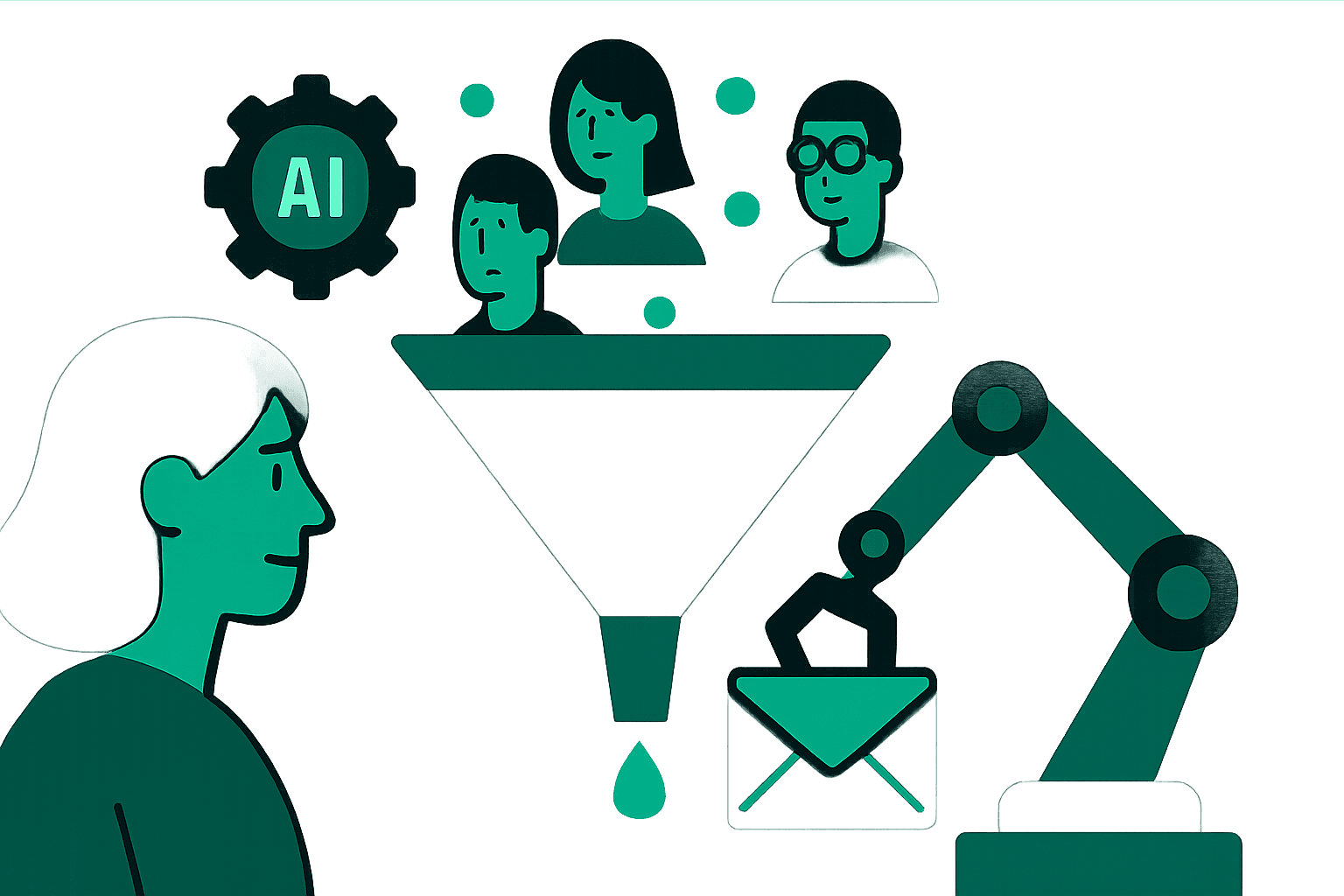
A funnel isn't a marketing buzzword. It's a system consisting of four building blocks:
- An ad that addresses a specific problem.
- A landing page that explains how you solve the problem.
- A form that collects qualified inquiries.
- A follow-up that automatically guides prospects to a conversation.
That's it. You don't need more to start.
No complex CRM. No webinar funnels. No 17-part email sequence. Just a clear path from "problem identified" to "appointment booked".
The trick is: You're not building for everyone. You're building for one target audience, one problem, one offer.
Example: You're a tax advisor. Instead of "taxes for everyone", you offer "tax advice for tradespeople hiring their first employee". That's specific. That's searchable. That's automatable.
According to a Lexware survey of 2,924 self-employed and small business owners (May 19-22, 2026), 34% were already automating at least partial processes with AI. In September 2025, it was only 16%.
The numbers show: Those who start now have the advantage. Those who wait keep watching.
The 4 Building Blocks of a Minimal Funnel
Building Block 1: The Ad
Your ad must address one specific problem. Not "more customers". Not "better marketing". But: "Check in 30 minutes why your website isn't generating inquiries."
One target audience. One problem. One call-to-action.
No exaggerated promises like "guaranteed 20 new customers". No fake scarcity. No pressure language.
For testing, two to three variants with different value propositions are sufficient initially. More just confuses the analysis.
Building Block 2: The Landing Page
Your landing page headline must match the ad. If you promise "website check in 30 minutes" in the ad, the landing page can't suddenly say "holistic online consulting".
Your landing page explains:
- Who the offer is for (and who it's not for).
- What problem you solve.
- What the process looks like.
- What results are realistic.
- What the next step is.
References only with verifiable consent. Privacy information visible. Imprint linked. Cookie consent if necessary.
AI can provide variants for headlines, objection handling, and FAQ drafts. But the decision about what you promise and what you deliver is yours.
Building Block 3: The Form
Only ask what you really need. For an initial inquiry, name, email address, concern, and optionally phone number are sufficient.
Qualifying questions can increase lead quality. But they shouldn't unnecessarily complicate submission.
Explicitly explain what you'll use the data for and how contact will be made. For promotional email communication, you need valid consent, often with double opt-in.
Legal review should be adapted to your specific purpose and target audience. No blanket statements.
Building Block 4: The Follow-up
Immediate confirmation after submission. Then a short sequence with concrete value:
- Context for the problem.
- Relevant tip or checklist.
- Case study or process.
- Invitation to a conversation.
Offer a clear opt-out from promotional messages. Only use WhatsApp with proper consent and privacy foundation.
Automation should enable handoffs to humans, not completely replace all communication.
Landing Page with AI in One Day
I know: You think a landing page takes weeks. That used to be true. Not anymore.
Here's how it works:
Morning: Preparation
Define in writing:
- Target audience (specific, not "all self-employed").
- Problem (in your customers' words).
- Offer (what happens after the inquiry?).
- Exclusion criteria (who is it not for?).
Collect ten to twenty original phrases from customer conversations, emails, or reviews. No invented sentences. Real quotes.
Don't feed AI with confidential customer data or personal information unless you have an appropriate legal basis and suitable data processing agreement.
Midday: Structure
Have AI create three to five variants for headlines and calls-to-action. Choose the best one. Not the most creative, but the clearest.
Structure your landing page:
- Problem (in the target audience's words).
- Benefit (what changes specifically?).
- Process (what happens after the inquiry?).
- Objections (what holds prospects back?).
- References (if available, with consent).
- Form (clear, short, understandable).
AI can provide FAQ drafts and objection handling. But the decision about what you promise is yours.
Afternoon: Implementation
Build the page technically. Check mobile view. Test the form. Ensure tracking and privacy are clean.
Before publishing: Read every sentence aloud. If it sounds like a brochure, rewrite it.
Learn more about how to create a complete website with AI in our comprehensive guide.
Automatic Follow-up via Email and WhatsApp
Email Sequence
A simple sequence to start:
- Message 1: Receipt confirmation and expectation management ("I'll get back to you within 24 hours").
- Message 2: Brief, concrete solution hint ("The most common cause of missing inquiries is…").
- Message 3: Common mistakes or checklist ("Check these 3 things before our conversation").
- Message 4: Example, reference, or process ("Here's how we solved this for client X").
- Message 5: Invitation to a conversation ("Let's talk for 20 minutes. Here's the link").
The sequence should be adapted to industry, consent, inquiry type, and processing status. No generic templates.
Only use WhatsApp if channel, purpose, and frequency are transparent and valid consent exists.
No automatic contact with phone numbers provided only for callback processing if additional advertising isn't covered.
Keep messages short. Limit to one specific action. Define response times, handoff to humans, and unsubscribe path.
WhatsApp isn't automatically the appropriate channel for sensitive information.
Traffic: Where Visitors Come From
A funnel without traffic is like a store without a window display. You need visitors. The question is just: from where?
Google Ads
Suitable for search queries with recognizable need. Advantage: Users are already searching for a solution.
Disadvantage: In highly competitive industries, clicks and leads can be expensive.
Set up search terms, exclusions, regional limitations, and conversion tracking properly. For local self-employed professionals, geographic restrictions and specific service terms can be more important than broad interest audiences.
According to Google Ads, Google rolled out new AI features in 2025. Specific availability may vary by account, country, campaign type, and rollout.
Meta Ads
Suitable for problem-oriented offers, local services, visual topics, and remarketing.
Test creatives regularly. Not just audience variants. Lead forms can simplify submission but require particularly careful requalification.
According to Projecter, Meta rolled out Advantage+ Leads campaigns globally in 2026. The previous "Automated Ads" format was scheduled to be discontinued the following year.
Learn more about how to win real inquiries with Facebook Ads on a €500 budget in our practical guide.
Particularly relevant for B2B offers and professional audiences. Native lead forms reduce media breaks but can also generate more unqualified contacts.
Expected lead value should be compared to higher platform costs.
Organic Channels
Referrals, local search engine optimization, expert articles, newsletters, webinars, and partnerships.
They don't necessarily incur direct click costs, but significant time or production effort.
For self-employed professionals, a funnel is often more effective when leveraging existing trust traffic rather than immediately relying exclusively on paid ads.
Learn how to optimize your Google Business Profile with AI and get more calls in a separate article.
Metrics That Matter
I get it: You want to know if it's working. But look: Most self-employed professionals measure the wrong things.
They're happy about "50 leads for €300". And only realize later: Not a single lead responded.
These metrics are important:
Top of Funnel
- Impressions: How often was the ad delivered?
- Click-through rate: Ratio of clicks to impressions.
- Cost per click: Media costs divided by clicks.
Middle of Funnel
- Landing page conversion rate: Percentage of visitors who submit the form.
- Cost per lead: Advertising and tool costs divided by leads.
- Qualification rate: Percentage of leads that match the target audience and offer.
- Cost per qualified lead: Total costs divided by qualified leads.
Bottom of Funnel
- Appointment rate: Percentage of leads who book an appointment.
- Show-up rate: Percentage of booked appointments that actually happen.
- Close rate: Percentage of qualified conversations resulting in a project.
- Customer acquisition cost: Total sales and marketing costs divided by customers won.
- Revenue and contribution margin: Not every low-cost lead is economically valuable.
Important: "Leads" shouldn't be optimized alone. A cheap lead can be worthless if they're unreachable, unsuitable, or unwilling to pay.
According to an industry source, B2B lead costs in the DACH region averaged €125 per lead in 2025, with a 15% increase over the previous year. This value should only serve as a rough market indication, not as a benchmark.
What I'd Do Differently: Avoiding Common Mistakes
I've seen hundreds of funnels in recent years. Most fail for the same reasons:
Mistake 1: Too Broad an Offer
"Marketing for all self-employed professionals" isn't an offer. It's an excuse not to commit.
Mistake 2: Ad and Landing Page Don't Match
Ad promises "website check in 30 minutes". Landing page explains "holistic online consulting". The prospect feels deceived.
Mistake 3: Too Many Form Fields
Asking for revenue, employee count, and future plans before initial trust-building gets no responses.
Mistake 4: AI Texts Remain Generic
"We offer innovative solutions for demanding clients." Everyone says that. No one really says that.
Mistake 5: No Definition of a Qualified Lead
If you don't know what a good lead is, you can't recognize one. And can't automate.
Mistake 6: Automated Responses Feel Impersonal
"Thank you for your inquiry. We'll be in touch." Sounds like 2005. Is 2005.
Mistake 7: WhatsApp Without Consent
Just because someone provides their phone number for a callback doesn't automatically allow you to send WhatsApp advertising.
Mistake 8: Only Measuring Clicks and Leads
If you don't measure how many leads become appointments and projects, you're optimizing in the wrong direction.
Mistake 9: Test Phase Too Short
Three days isn't a test. Three leads isn't a test. Three weeks and 50 leads is a start.
Mistake 10: No Emergency Process
What happens if the form, CRM, email, or automation fails? If you don't know, you're losing inquiries.
The First Step You Can Take Today
You don't have to know everything. You just have to start.
Here's the concrete first step for today:
Write on a piece of paper:
- Who is my offer really for? (Not "everyone", but "tradespeople with their first employee".)
- What one problem do I solve? (In my customers' words, not mine.)
- What's the next step after the inquiry? (Conversation? Check? Proposal?)
That's it. You don't need more today.
Tomorrow you can build the landing page. The day after, launch the ad. But today, this one step is enough.
According to a Bitkom study, 76% of respondents expect increasing importance of marketing automation. The question isn't whether you automate. But when.
Find more practical guides in our online marketing guide for self-employed professionals and our AI marketing handbook.
If you don't want to do it alone or want to be faster, you can start with Nelija for free. Nelija helps you build the funnel step by step. No pressure. No hidden costs. Just start: Try Nelija for free.
Frequently Asked Questions
How can I automate my lead generation without personally pre-qualifying every lead?
Build qualifying questions into the form and define clear criteria for a good lead. AI can analyze responses, sort by urgency, and send standard replies. You make the final decision about whether a lead fits after a quick look at the summary.
What four elements does a simple funnel need for my first inquiry?
Ad, landing page, form, follow-up. You don't need more to start. No CRM, no webinar, no 17-part email sequence. Just a clear path from problem to appointment.
How much ad budget do I need to test meaningfully with Google Ads or Meta Ads?
For an initial test, €300 to €500 over two to three weeks is sufficient. The goal isn't to have immediately profitable campaigns, but to learn: Which ads work? Which audiences convert? Which landing page convinces?
Can I automatically contact prospects via WhatsApp after a form inquiry?
Only if you've obtained valid consent for WhatsApp communication. A phone number for a callback doesn't automatically authorize WhatsApp advertising. Clearly explain in the form which channels you'll use and obtain consent explicitly.
What data can I request in a lead form?
Only data necessary for processing the inquiry. For an initial inquiry, name, email address, concern, and optionally phone number are sufficient. Qualifying questions are allowed if they improve consultation. Revenue, employee count, or future plans come later in the conversation.
How do I prevent AI texts from sounding generic or unbelievable?
Feed AI with real customer phrases, concrete examples, and your own language. Avoid clichés like "innovative solutions" or "holistic consulting". Read every sentence aloud. If it sounds like a brochure, rewrite it.
Which metric is more important: cost per lead or cost per customer acquired?
Cost per customer acquired. A €5 lead is worthless if no one responds. A €50 lead is valuable if every third becomes a customer. Don't just measure leads, but qualified leads, appointments, show-ups, closes, and contribution margin.
How quickly should I respond to an automatically received inquiry?
Immediately with a confirmation. Within 24 hours with a personal response or appointment suggestion. The longer you wait, the higher the probability the lead goes to a competitor.
Do I need a CRM for an AI funnel or is a spreadsheet initially sufficient?
A spreadsheet is sufficient to start. What's important is documenting source, date, status, qualification, and next steps. When you have more than 20 leads per month, a simple CRM or automation tool becomes worthwhile.
How do I recognize if a lead really fits my offer?
Define clear criteria beforehand: target audience, budget, urgency, problem. Ask qualifying questions in the form or first conversation. AI can analyze responses and suggest whether a lead fits. You make the final decision.
Comments
Comments are only available when you are signed in. You are self-employed and want access to Nelija.com, including a free website? Message Nelija directly.