AI Agents with Dots: Prepare Campaigns Without Publishing Blind
 Nelija
Contents
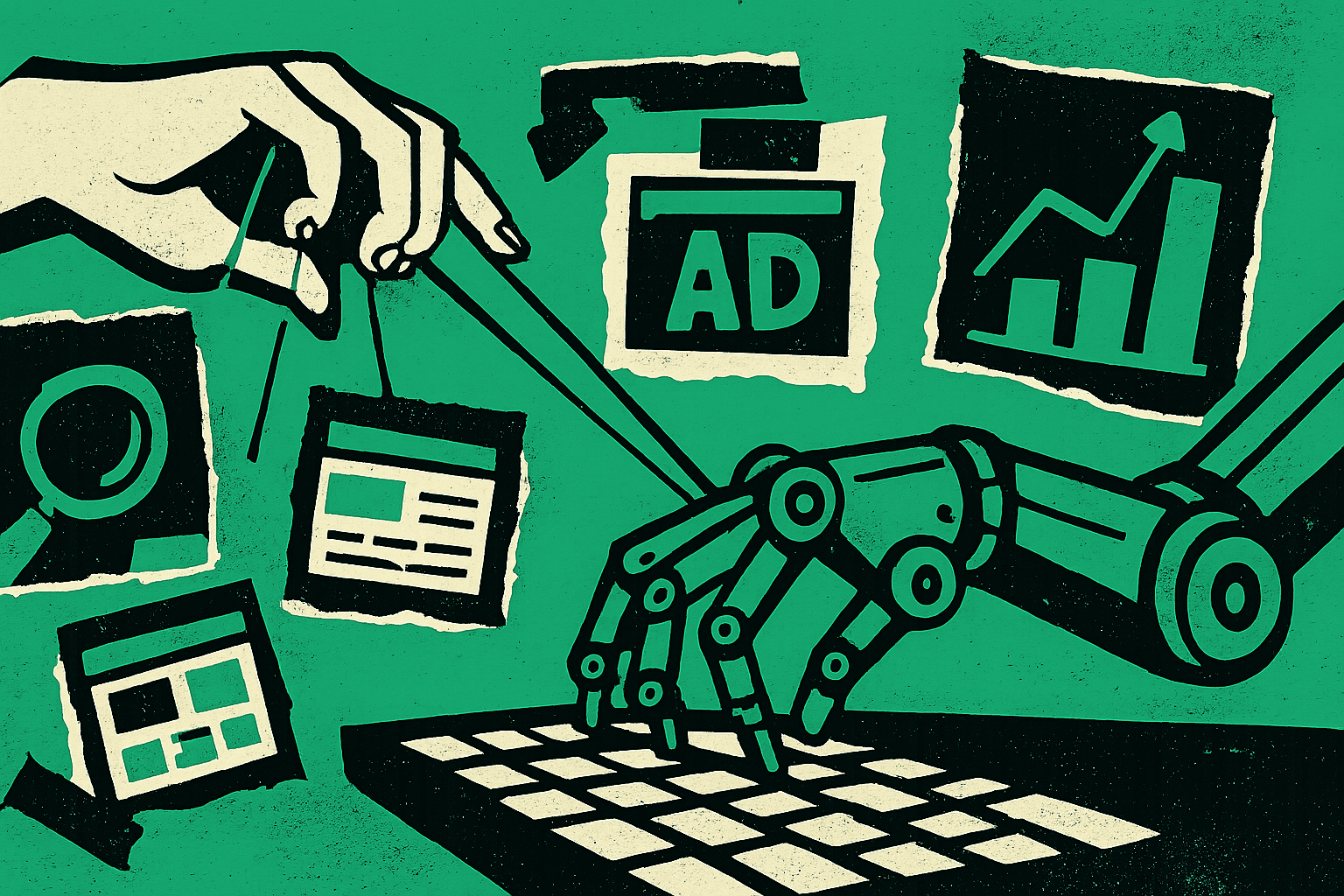
An AI agent can prepare ad campaigns, draft copy and calculate budgets for you. But it shouldn't manage your ad spend or publish campaigns unchecked. The safe path starts with drafts, not full automation.
Here's the thing: you can already delegate a lot of prep work to AI today. Research, structuring, variant creation, copy suggestions. But there's a huge difference between preparation and publication. And that's exactly where the responsibility lies that you shouldn't delegate.
What OpenAI Dots Can Do for Marketing Tasks
On 29 September 2026, OpenAI introduced Dots: persistent agents with their own cloud computer, storage and access to connected applications (source). Reports indicate that Dots can connect with over 4,000 applications (source).
For marketing tasks, tools like Canva, Adobe, HubSpot, Klaviyo, Ahrefs and Figma are mentioned (source). This opens up potential use cases:
- Translate briefs into tasks and checklists
- Prepare keyword and competitor research
- Draft ad variants and landing page copy
- Prepare creative assets as drafts
- Summarise campaign reports
- Conduct recurring checks and reporting
Important: according to available reports, a Dot isn't automatically an authorised publisher. Actions like publishing or changes should be controllable through additional security checks, rules or human approval (source).
Available sources don't reliably confirm that OpenAI Dots officially had native Google Ads or Meta Ads functionality as of 13 October 2026. One report describes an open-source Google Ads API server with initially read-only access and third parties that create campaigns and initially set them as paused (source).
This means: an AI agent for ad campaigns is today a preparation and control system. Not an autonomous ad manager. Its strength lies in research, structuring, variant creation, documentation and checking. Not in publishing.
Which Campaign Elements an Agent May Prepare
Not every task is equally critical. You can entrust an agent with a lot, as long as you retain control over budget, audience and publication.
Low-Risk Preparation Tasks
- Derive campaign structure from the brief
- Suggest campaign, ad group and ad naming
- Formulate audience hypotheses
- Collect keywords and negative keywords
- Write ad copy in multiple variants
- Check landing page content against the brief
- Create UTM structures and tracking checklists
- Calculate budget variants
- Document risks, assumptions and open questions
Tasks with Limited Permissions
- Create drafts in ad platforms
- Generate ad images or videos as drafts
- Prepare tracking parameters in a test environment
- Consolidate reports from ad, CRM and analytics platforms
- Flag deviations in costs, clicks or leads
Tasks That Should Stay with Humans
- Set final audience and exclusions
- Approve legally relevant statements
- Select sensitive audiences or special categories
- Set daily and monthly budgets definitively
- Publish campaigns
- Automatically increase bids or budgets
- Change conversion definitions
- Transfer personal data to new systems
- Activate campaigns with high financial or reputational risk
Meta Advantage+ already automates audience targeting, placements and budget distribution to a large extent (source). An additional AI agent therefore shouldn't uncontrollably override the same decisions, but rather document and monitor the platform logic.
Brief, Audience and Offer as Clear Input
A good agent needs a good brief. Without clear specifications, you'll get generic suggestions instead of specific campaigns.
The brief should contain at least:
- Business and campaign objective
- Specific offer
- Price or pricing model
- Geographic area
- Duration
- Target audience
- Exclusion groups
- Available evidence
- Desired conversion
- Maximum cost per lead or sale
- Permitted advertising claims
- Budget ceiling
- Approval person
Instead of "Create a campaign for my offer", the instruction should specify, for example:
- "Create three campaign drafts for a local service."
- "Publish nothing."
- "Use a maximum of £700 as planning framework."
- "Flag every unsubstantiated claim."
- "Separate facts, assumptions and suggestions."
- "Create an approval list for budget, copy, audience and tracking."
A good agent brief should also include a negative list:
- No medical efficacy claims
- No guaranteed results
- No fabricated customer testimonials
- No unsubstantiated price or performance claims
- No use of personal customer data without clear legal basis
- No publication without human approval
The agent should label every output with a status:
- Fact: taken directly from brief, website or approved data source
- Assumption: added for planning, must be verified
- Suggestion: creative or strategic option
- Risk: possible legal, tracking, budget or brand error
How to Check Copy, Budget and Tracking
A draft is only as good as the review. Here are the three most important checkpoints.
Copy Review
- Does every claim match the website, offer and terms?
- Are prices, discounts and deadlines current?
- Are results guaranteed or presented as possibilities?
- Are audience targeting and tone appropriate?
- Do ads contain prohibited or sensitive attributes?
- Are character limits and platform requirements met?
- Are there variants for different search intents?
Budget Review
Daily budget and duration must mathematically align. The agent should deliver at least three scenarios: cautious, normal and ambitious.
Each variant should include assumptions about cost per click, click-through rate, conversion rate and cost per conversion. Example: with a £500 monthly budget and an assumed cost per click of £2, 250 clicks would be mathematically possible. This is a model calculation, not a forecast.
The agent must not derive a budget increase from a single good day's performance. For small businesses, a fixed maximum loss amount should be agreed.
Tracking Review
- Define conversion event in ad account
- Perform test click and test conversion
- Check UTM parameters
- Compare attribution in Analytics, CRM and ad platform
- Exclude duplicate conversions
- Check consent and privacy processes
- Align time zones and currencies
- Import offline conversions only from approved data sources
Google announced Ads Advisor and Analytics Advisor; according to the available product announcement, they're scheduled to be available for English-language accounts from December 2026 (source). This date is after the current article date and should be understood as an announced, not yet generally available feature.
Why Paused Campaigns Are a Safety Net
A campaign created in paused state separates technical preparation from financial activation. This is the most important protection mechanism.
Humans can check before activation:
- Target URL
- Target region
- Target audience
- Bidding strategy
- Daily budget
- Duration
- Ad approval
- Tracking
- Exclusions
- Billing account
Third-party providers for agent-supported ad processes are described in search results as solutions that initially create new campaigns paused for review (source). This is a sensible security pattern, but not proof that every Dots integration supports this function by default.
The pause logic should be supplemented with a four-eyes approval:
- Agent creates
- Self-employed person reviews
- Platform shows preview
- Human activates
- Agent monitors
- Human decides on changes
A pause doesn't protect against all errors. Even paused campaigns can contain wrong URLs, impermissible copy, incorrect audiences or misconfigured tracking events. The pause only prevents these errors from immediately triggering ad spend.
A Practical Process for Your First Agent Campaign
Here's how to proceed step by step when you want to use an AI agent for ad campaigns for the first time.
1. Define Objective
Define a single primary conversion. Example: qualified enquiry, appointment booking or purchase.
2. Limit Data
Connect only necessary accounts. Initially avoid write permissions. Use customer data and exports only if purpose, authorisation and privacy are clarified.
3. Create Brief
Document offer, audience, region, budget, duration, exclusions and approval rules.
4. Formulate Agent Task
Prepare campaign only as draft. Mark every assumption. Allow no publication and no budget changes.
5. Generate Variants
Have multiple messages, headlines, calls-to-action and audience hypotheses developed. Don't let variants be tested automatically, but prioritise them first.
6. Execute Checklist
- Copy
- Audience
- Budget
- Landing page
- Tracking
- Privacy
- Platform policies
7. Create Paused
Create campaign, ad groups and ads in paused state. Archive screenshots or export of configuration.
8. Human Approval
Compare all changes since draft. Confirm budget ceiling. Perform test conversion.
9. Activate
Manually activate campaign. Don't allow automatic budget increases.
10. Monitor Controlled
Only evaluate after a pre-defined review interval. Don't react to individual clicks or a single day. Make changes individually and documented.
What a Small Test Costs in the UK
Available sources often cite an ad budget of around £400 to £1,300 per month for small local campaigns. These are market and provider recommendations, not reliable general UK studies.
For small businesses, including management, figures of £850 to £2,500 per month are sometimes mentioned; depending on the model, around £400 to £1,300 of this should go to ad spend and £400 to £1,300 to management.
Mentioned entry values for individual channels:
- Google Ads: from around £250 per month
- Meta/Instagram Ads: from around £125 per month
- Google search ads: approximately £0.80 to £7 per click
For Google Ads, another source mentions click prices of approximately £0.40 to £10 in the UK market, with exceptions up to £20. Such ranges depend heavily on industry, search term, competition, location and ad quality.
Recommendation for your first test:
- Small local test: £400 to £850 ad budget
- Regional test: £850 to £2,500 ad budget
- Show management, creative production and technical setup separately
These ranges are derived from provider information and should be understood as guidance.
What I'd Do Differently
I know this: you want to start quickly, and the AI tells you it can handle everything. That's tempting. But I'd approach it differently today.
I wouldn't give the agent overly broad account permissions. Instead: only read permissions for reports, only draft permissions for campaigns. No publishing or budget change permissions.
I wouldn't use "Optimise the campaign" without budget, time and risk limits. Instead: clear rules. "Don't change the budget. Flag suggestions. Publish nothing."
I wouldn't let drafts be published directly. Instead: create everything paused, review, then activate.
I wouldn't accept numbers from agent research as facts without verification. Instead: check every number with source and context.
I wouldn't formulate audience and offer too generally. Instead: be specific. "Tradespeople in Manchester offering bathroom renovations from £5,000."
I wouldn't check tracking only theoretically without performing a test conversion. Instead: perform a real test click and real test conversion before the campaign goes live.
I wouldn't change budgets after a few clicks or a single day. Instead: wait at least three days, then evaluate.
I wouldn't confuse paused campaigns with safely reviewed campaigns. Instead: paused only means it's not running. Not that it's error-free.
Best Practices for Controlled Agent Use
- Least Privilege: grant only the minimum required permissions.
- Draft before publication: always create campaigns paused.
- Human in the loop: keep budget, audience, legal statements and activation with humans.
- Four-eyes principle: introduce a second review for larger budgets or sensitive industries.
- Clear agent rules: no publications, no budget changes, no data imports without approval.
- Justification requirement: every recommendation must state assumptions, data source and expected effect.
- Change log: document before-after values, timing, reason and responsible person.
- Small tests: initially test one campaign, one objective and few variables.
- Fixed stop rule: define in advance when to pause, such as exceeded cost limit or faulty tracking.
- Regular permission review: regularly check connected apps and permissions.
- Check platform rules separately: agents can't replace policies.
- Data minimisation: use only aggregated or pseudonymised data where possible.
Frequently Asked Questions
Can an AI agent for ad campaigns publish my Google or Meta campaign directly?
No, not without your explicit approval. Most providers initially create campaigns paused. You review, then you activate.
What permissions should I give an agent for ad accounts?
Only read permissions for reports and draft permissions for campaigns. No publishing or budget change permissions. No access to customer data without clear legal basis.
Can an agent automatically increase my ad budget?
Only if you give it that permission. For the start, you shouldn't do that. Budget changes stay with humans.
How do I prevent an AI from writing false promises into my ads?
With a clear brief and a negative list. The agent may not use guarantees, unsubstantiated claims or fabricated customer testimonials. And you review every text before approval.
Why should I have campaigns created paused initially?
Because paused campaigns are technically complete but don't yet spend budget. You can review in peace before the campaign goes live. That's your safety net.
How do I check if conversion tracking really works?
Perform a test conversion. Click on your own ad, fill out the form or complete the purchase. Check if the conversion arrives in Analytics, CRM and ad platform. Only then activate the campaign.
How much ad budget does a small campaign need in the UK?
For a first test, £400 to £850 ad budget is sufficient. This is guidance from provider information, not a success guarantee. Actual costs depend on industry, region and competition.
Can I connect an agent with CRM or customer data without creating privacy risks?
Only if purpose, authorisation and privacy are clarified. You shouldn't transfer personal data without clear legal basis. Aggregated or pseudonymised data is safer.
What may the agent decide itself, and what stays with me?
The agent may create drafts, suggest variants, summarise reports and document risks. You decide on budget, audience, legal statements and publication.
How long should I wait before evaluating a campaign?
At least three days. Don't react to individual clicks or a single day. Only evaluate after a pre-defined review interval.
The Step You've Been Postponing for Years
You know you should run ads. But you also know how quickly budget disappears if you're not careful. And that's exactly why you keep putting it off.
AI can take a lot of prep work off your hands today. But it shouldn't manage your ad budget unchecked. The safe path starts with drafts, not full automation.
You don't have to know everything. You just have to start. With a clear brief, a paused campaign and a checklist. Then you activate. Then you observe. Then you learn.
That's the step you've been postponing for years. And it's smaller than you think.
If you don't want to start alone or want to progress faster: Try Nelija for free. No pressure. No risk. Just a tool that helps you take the first step.
Find more on this topic here: Running ads for self-employed people, Setting up ad campaigns and Optimising campaigns.
Comments
Comments are only available when you are signed in. You are self-employed and want access to Nelija.com, including a free website? Message Nelija directly.